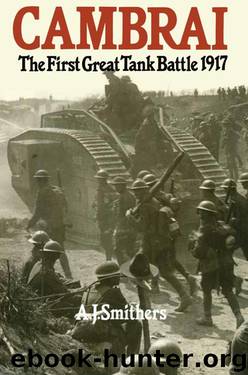
Cambrai: The First Great Tank Battle by A.J Smithers
Author:A.J Smithers [Smithers, A.J]
Language: eng
Format: epub
ISBN: 9781473803305
Publisher: Leo Cooper
Published: 1992-06-30T21:00:00+00:00
⋆ Cyril Falls, Captain of Foot and Professor of History, was there with the 36th Division. He has always maintained that Tudor deserves as much credit as Elles for the entire conception of an armoured attack.
CHAPTER SEVEN
* * *
‘WAS EVER A BATTLE LIKE THIS IN THE
WORLD BEFORE?’
* * *
The Revenge
Alfred, Lord Tennyson
The parcel of France selected for the new battle was not new to the British Army. In the years after Waterloo both Cambrai and Valenciennes had been garrison towns, the former housing the Grenadier Guards under Colonel the Hon William Stewart and the latter Colonel Woodford’s battalion of the Coldstream. Harry Smith, Rifleman and husband to the famous Juana, was Town Major of Cambrai, whilst Charlie Beckford held the equivalent position at Valenciennes. In Bourlon Château lived the Duke himself, his hounds sharing Bourlon Wood with those of the Smiths. When Colonel Hobart came to see it for the first time in 1935 he remarked that it reminded him of Salisbury Plain: ‘As a rough comparison the battle could have been fought in an area bounded by Upavon-Amesbury-Shrewton-Urchfont Clump.’
The names of Caudry, Inchy, Cambrai and Le Cateau had appeared in the newspapers of 1914 when Sir Horace Smith-Dorrien had fought von Kluck to a standstill and saved the BEF from annihilation. The six miles of chalk down running south-east from the Bourlon heights had seen some fighting earlier in 1917, especially round the heavily-fortified La Vacquerie, though not on the Flanders scale. For the Tank Corps they were the nearest thing possible to nursery slopes. As soon as the participants came under starter’s orders a mighty secrecy afflicted everybody. Surprise was the word of power. Those officers whose business it was to go forward and inspect the ground over which they were to operate denied their identities with false badges and plain burberries: ‘One well-known Staff Officer even went to the length of wearing blue glasses; in fact in the matter of disguise the line was only drawn at ginger whiskers…. Staff and Reconnaissance officers slunk about, above all avoiding Headquarters and those other social centres which etiquette enjoins must first be called upon by all who visit other people’s trenches…. At the First Brigade Headquarters in Arras there was a locked room with “No Admittance” written large upon the door. Here were ostentatiously hung spoof maps of other topical districts and a profusion of plans lay spread about.’ The Tank Corps was in merry pin, seeing at last the opportunity of doing what it had been intended for. Highlanders about the place were made to wear trousers. The part of the artillery, in order not to excite alarm in the Hindenburg Line, was to keep up exactly the daily amount of shell fire and of the same kind as had become customary. It was of the highest importance that the men of General von der Marwitz, commanding the Kaiser’s Second Army, should be persuaded that their adversaries harboured no evil intentions towards them.
The two divisions in the line, 20th and 36th, were kept busy.
Download
This site does not store any files on its server. We only index and link to content provided by other sites. Please contact the content providers to delete copyright contents if any and email us, we'll remove relevant links or contents immediately.
